Ever search for a rookie card and find a dozen listings that look nearly identical? One says Silver, another says Refractor, and another has a serial number. The player may be the same, but the cards—and the comparisons that make sense—can be very different.
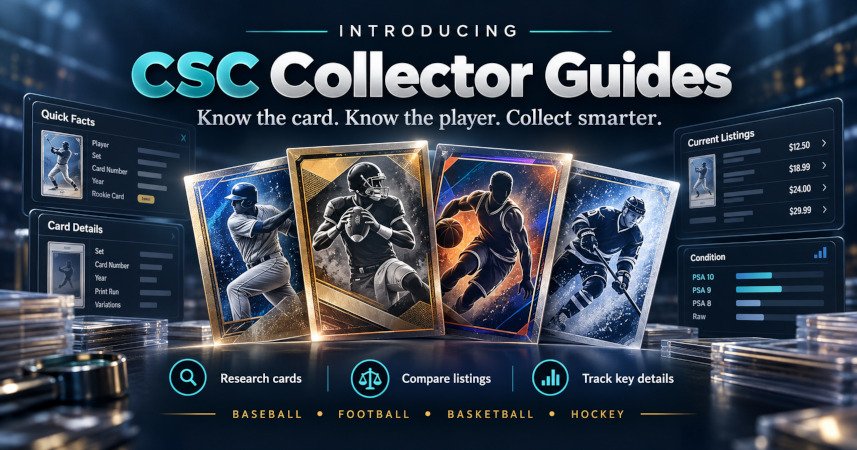
That’s why we’re introducing CSC Collector Guides at Collect Sports Card: a growing library designed to help collectors identify the right card, understand its place in the hobby, and research current marketplace options with better context.
Our goal is simple: Know the card. Know the player. Collect smarter.
Start with the exact card—not just the player’s name
Before comparing sports card prices, you need to know what you’re comparing. A card’s year, manufacturer, set, number, parallel, autograph status and serial numbering can all matter. Searching only by player name can mix base cards, inserts, variations and graded copies into one confusing set of results.
CSC guides put those identifying details up front in an easy-to-scan Quick Facts section. For example, the 2018 Topps Update Shohei Ohtani #US1 rookie guide keeps the US1 designation front and center, while our 2000 SP Authentic Tom Brady #118 guide explains why its Future Watch /1250 designation is part of the card’s identity.
The benefit: fewer mismatched comparisons, clearer searches and more confidence that you’re researching the version you actually own—or want to buy.
Research you can follow back to the source
Collector research should be more than a collection of search results. CSC Collector Guides bring together card and set background, identification notes, and links to supporting sources where available—including manufacturer checklists, grading references and official sports records.
That context helps answer the questions collectors encounter every day: Is this the base issue or a parallel? Is the card actually considered a rookie? Does a serial-number denominator identify the print run, or is someone mistaking it for the number of surviving copies?
Our 2003–04 Topps Chrome LeBron James #111 Refractor guide is a good example of why a card’s precise variation deserves its own research page.
The benefit: make decisions using traceable card details instead of relying on vague listing titles or hobby hype.
Compare current eBay listings—with pricing context
Price research is one of the most frustrating parts of the hobby, especially when similarly titled listings represent different versions or grades. Where matching marketplace listings are available, CSC guides bring selected current eBay offers into the research experience, with listing photography, listing titles, asking prices and retrieval timestamps. Links also help you explore more offers for the same card.
There’s an important distinction: an asking price is not a completed sale, a verified market value or an appraisal. A seller-stated grade is not independent verification of a card’s condition. CSC labels these differences so you can use marketplace listings as one input—not mistake them for a guaranteed value.
Marketplace disclosure: CSC may earn a commission if you buy through eBay links in our guides.
The benefit: move from learning about a card to examining real marketplace options without losing track of the exact issue you’re researching.
Understand the player, the history and the condition
Cards are more than checklist entries. Our guides explain why particular issues matter to collectors, whether that’s a player’s early-career rookie, a distinctive parallel, a historic set or a memorable moment in a legend’s career.
For active players, selected guides include dated performance snapshots and research-review information, making it clear when the player context was checked. For retired greats, the focus can shift to career legacy and the history of the card itself.
Condition guidance adds another practical layer: what to inspect on corners, edges, surfaces, centering, print quality, grading labels and serial stamps. The 1979–80 O-Pee-Chee Wayne Gretzky #18 rookie guide shows why borders and print characteristics deserve attention alongside the player’s name.
The benefit: research that supports smarter collecting—not just a faster shopping search.
Four sports. One collector-first approach.
Whether your collection centers on today’s stars or legendary names, there’s a place to start in :
- Baseball Collector Guides — flagship rookies, Bowman-era prospects, vintage legends and important variations.
- Football Collector Guides — modern rookies, numbered issues and iconic NFL cards.
- Basketball Collector Guides — rookie-year Chrome, Prizm parallels and historic basketball cards.
- Hockey Collector Guides — Young Guns, legendary rookies and classic hockey issues.
We’re building out this library over time, with the same emphasis on clear identification, research transparency and practical collector value.
A smarter starting point for your next card
The next time you’re researching a possible purchase, a listing price, or a card already in your collection, start by establishing the exact issue. Read its card and set context. Review the condition factors that matter. Then compare relevant marketplace listings with independently verified completed-sale data from other sources, when available. CSC’s current eBay listings show asking prices, not sold-price evidence.
CSC Collector Guides are not a promise of future value or a substitute for inspecting the actual card. They’re a better foundation for asking the right questions.
Explore All CSC Collector Guides →
Know the card. Know the player. Collect smarter.